What the Body Remembers
The Sama-Bajau have spent a thousand years at sea. The sea wrote itself into their biology. Now the sea is being taken from them — and what happens to a body when the life that made it disappears.
“The sea did not give the Sama-Bajau their enlarged spleens. A thousand years of choosing the water did.”
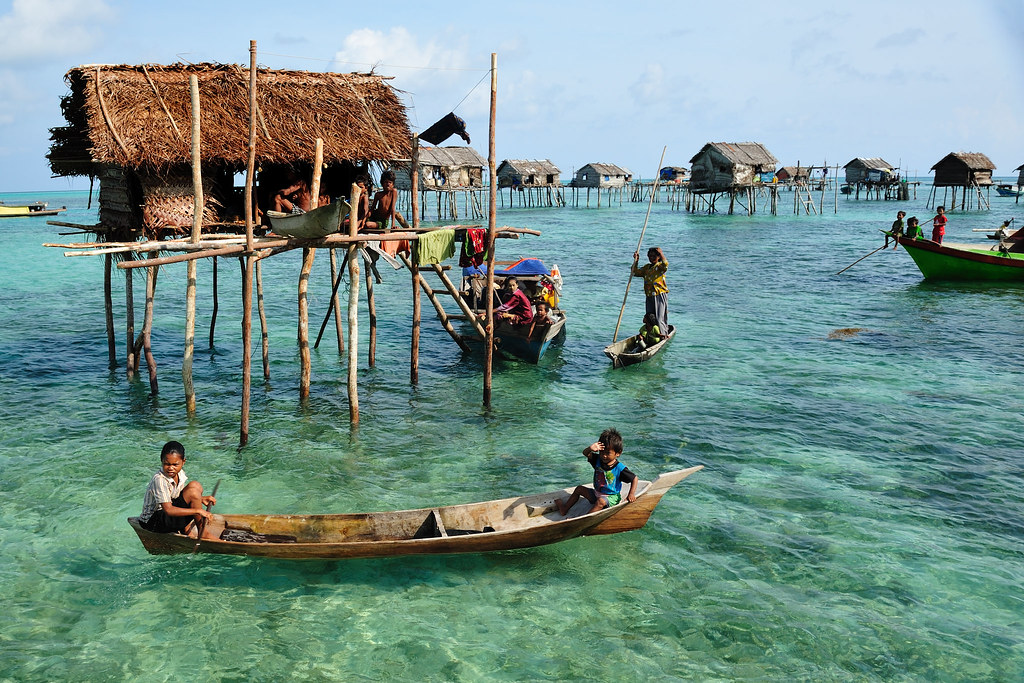
Before she can walk, she is already swimming. This is not metaphor and it is not a story parents tell to make their children feel brave. It is, for many children born into Sama-Bajau communities across the Sulu and Sulawesi Seas, simply the order in which things happen. The water comes first. The land comes later, if it comes at all.
The Sama-Bajau — whose name, in the Austronesian root shared by all their many subgroups, means *together*, means *kin* — have lived on and in the sea for over a thousand years. Not beside it. Not visiting it. On it, in fleets of handmade wooden houseboats called *lepa*, in clusters of extended family, navigating by tides and stars across waters that predate every national border that now crosses them. During a typical working day, a Sama-Bajau diver spends up to five hours underwater. Some can hold their breath for thirteen minutes. They descend to sixty metres wearing wooden goggles they made themselves.
In 2018, a geneticist named Melissa Ilardo, then at the University of Copenhagen, published a paper in the journal *Cell* that confirmed what the Sama-Bajau had always known about themselves in a different vocabulary: the sea had changed them. It had worked its way into their genes.
The spleen, in most mammals, functions as a biological oxygen reserve. During a dive — any dive, in any species — the spleen contracts and releases a surge of oxygenated red blood cells into the bloodstream, extending the body's capacity to function without breathing. In seals and other marine mammals this mechanism is extreme and well-documented. In humans it has always existed but was thought to be marginal.
Ilardo measured the spleens of forty-three Sama-Bajau individuals using portable ultrasound equipment, in the Indonesian village of Jaya Bakti in Central Sulawesi, and compared them with a genetically similar neighbouring group, the Saluan, who live twenty-five kilometres away and do not dive. The Sama-Bajau spleens were approximately fifty percent larger than the Saluan's. This was striking. What was more striking was what happened next.
Ilardo found that the enlarged spleens were present not only in active divers but in non-diving Sama-Bajau individuals as well — elderly people who had stopped diving, children who had not yet started, community members who had moved to shore. The spleen size was not a consequence of diving practice. It was a consequence of a thousand years of divers having larger spleens and, because larger spleens meant more oxygen per dive and more food per day, passing that advantage on. The Sama-Bajau carry a variant of a gene called PDE10A, which the Saluan do not, associated with the enlarged spleen and with the thyroid function that regulates metabolic response to cold and hypoxia. The sea did not give the Sama-Bajau their spleens. A thousand years of choosing the water did.
This is the first documented case of genetic adaptation to a diving lifestyle in humans. It will not be the last discovery. Sama-Bajau children also develop unusually sharp underwater vision — not through genetics, it appears, but through the plasticity of the young eye trained to focus through salt water from infancy. The two mechanisms are different: one written into DNA over centuries, one learned by each child in the first years of life. Both require the same thing. They require the water.
Here is what the science does not capture, because science measures the present and the measurable: the Sama-Bajau adaptation is the distillation of a way of being in the world that is not merely a lifestyle but a philosophy, an economy, a theology, and a set of relationships with other living things that cannot be separated from the biology and assessed independently.
The Sama-Bajau creator deity, *Umboh Tuhan* — also known as *Umboh Dilaut*, the Lord of the Sea — is understood to have made humans equal to animals and plants. Not above them. Not their stewards. Their siblings in a shared order. This is not animism in the diminishing sense the word is sometimes used; it is a cosmological position about the structure of creation. The diver and the fish are the same order of being. The reef is not a resource; it is kin. Before a fishing season opens, the community performs the *pagkanduli* — a gathering of thanks, music, and offerings to *Umboh Tuhan* and to the *umboh*, the ancestor spirits whose goodwill determines whether the sea will give. Before the dive, the diver asks. Permission is not assumed. It is sought.
“Taking from the sea is not a right to be exercised. It is a request to be made — and the request can be refused.”
This is the most sophisticated conservation framework in this brand's cultural foundation, and it is sophisticated precisely because it does not recognise itself as conservation at all. There is no programme. There is no reporting. There is a theology that makes overfishing a form of bad faith with the divine, and the reef is healthy where the Sama-Bajau have been its keepers because the theology forbids extraction more effectively than any law.
Or it did, until the law arrived and pushed them off the reef.
The modern nation-state was not designed with the Sama-Bajau in mind. Three of them — Malaysia, the Philippines, and Indonesia — now divide the waters the Sama-Bajau have crossed freely for centuries. Their traditional mobility, which was itself a form of ecosystem management (following fish across seasonal ranges, resting reefs by moving on), became illegal overflight of maritime borders. Their houseboats, which predate the concept of land title, could not be registered. Their children, born on water between jurisdictions, could not be documented. As of 2024, approximately seventy-eight percent of Bajau Laut living in Sabah, Malaysia, are stateless or undocumented. They exist, biologically and culturally, but they do not exist on paper.
Statelessness is not an abstract condition. It means no legal right to fish in anyone's territorial waters. It means no access to public healthcare for the compressed-air injuries that have become common since divers began using compressors — compressors being cheaper than the years of practice it takes to equalise safely without them, and faster, and deadlier. Decompression sickness, unknown in traditional Sama-Bajau free-diving, has become a significant cause of disability and death in communities that can no longer afford the time to dive the old way. The body the sea made over a thousand years is being unmade, rapidly, by an economics of desperation.
Ilardo's research found that non-diving Sama-Bajau still carry the enlarged spleen. The body remembers what the life no longer practises. But the question the biology cannot answer is how many generations of shore-dwelling, of compressor-diving, of eating food bought with cash instead of caught on a breath, it takes before the adaptation attenuates. No one knows. The research has not been done. What is known is that the adaptation developed over approximately a thousand years of sustained aquatic life, and that sustained aquatic life is what is ending.
The children who learn to swim before they walk are still being born. For now.
同 — *onaji* in Japanese; *sama* in the Austronesian root the Sama-Bajau take their collective name from. Together. The same. Kin.
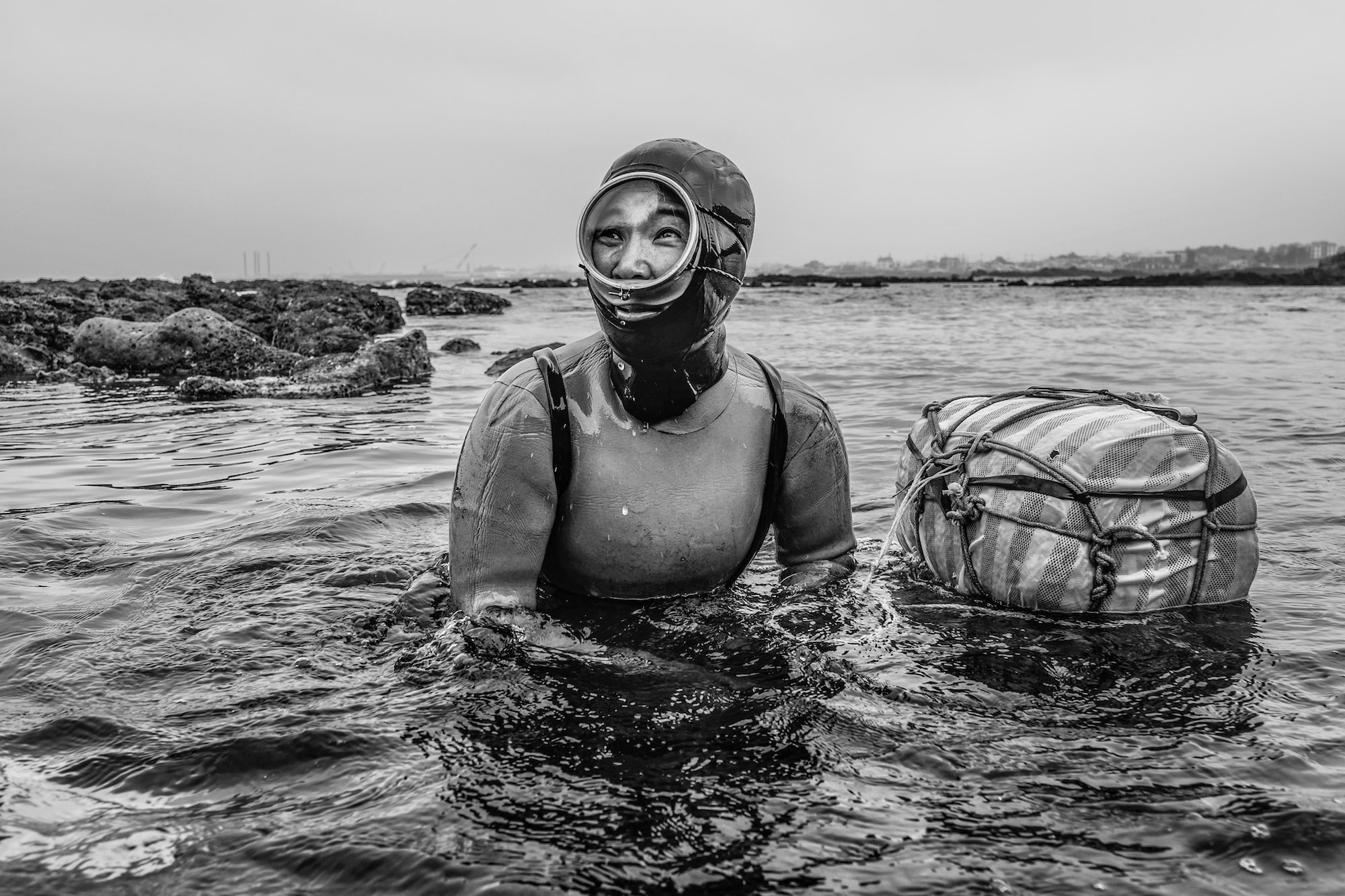
The three traditions in the Sisterhood section of this journal — the Haenyeo of Jeju, the Ama of Ise-Shima, the Sama-Bajau of the Sulu and Sulawesi Seas — have never, as far as anyone knows, met each other or exchanged knowledge. They have practised independently, on opposite shores of the same ocean, for centuries. And they have arrived at the same conclusions. The sea gives; you ask before you take; what the sea cannot replace, you leave. The diver and the fish are not different kinds of thing. The community outlasts the individual diver. The elder teaches by diving alongside the young, not by retiring from the water.
The Sama-Bajau version of these conclusions is written into their bodies in a way the other two traditions are not — or not yet measurably. A thousand years of living on the water produced not only a culture but a biology. The spleen is the proof. The enlarged spleen is a kind of inheritance, like the tools the Haenyeo pass from mother to daughter, like the pearl oyster quota the Ama return to the sea — except that the inheritance is the body itself, shaped over centuries by a relationship with the ocean that was serious enough, sustained enough, and reciprocal enough to alter the genome.
“That relationship is now being severed. The body will take longer to forget it than the law will take to enforce its forgetting.”
Shio no Wa's engagement with Sama-Bajau cultural heritage is governed by a protocol detailed in the brand's partnership framework: no product motif, no visual element, no named cultural reference drawn from Sama-Bajau tradition without a formal memorandum of understanding with a named community organisation, with explicit revenue-share terms and cultural consultation structure. This piece exists inside that framework. It is published as an act of attention — which is the minimum a brand that draws on a tradition owes to the people who live it — and not as an act of appropriation.
If you want to do more than read: the organisations working on Sama-Bajau statelessness, land and sea rights, and cultural preservation include UNHCR Malaysia's statelessness documentation programme, SUHAKAM (Malaysia's Human Rights Commission), and Coral Triangle Initiative partners working on indigenous fishing rights in the region. We will publish links in the next issue of *Letters from the Tide*.
About this piece
The genetic research cited throughout is drawn from Ilardo et al., "Physiological and Genetic Adaptations to Diving in Sea Nomads," *Cell* 173 (2018), a peer-reviewed study conducted in the Indonesian village of Jaya Bakti in Central Sulawesi. The cultural and ethnographic material draws on the work of Clifford Sather, Hanafi Hussin, and the broader Sama-Bajau ethnographic literature. The individual divers described are composites rather than named real individuals, consistent with Shio no Wa's approach to communities where formal research partnership has not yet been established. The brand is in early conversation with two researchers who work directly with Sama-Bajau communities in Sabah and Tawi-Tawi; we expect to be able to publish a fully sourced, community-reviewed piece in a future volume.